
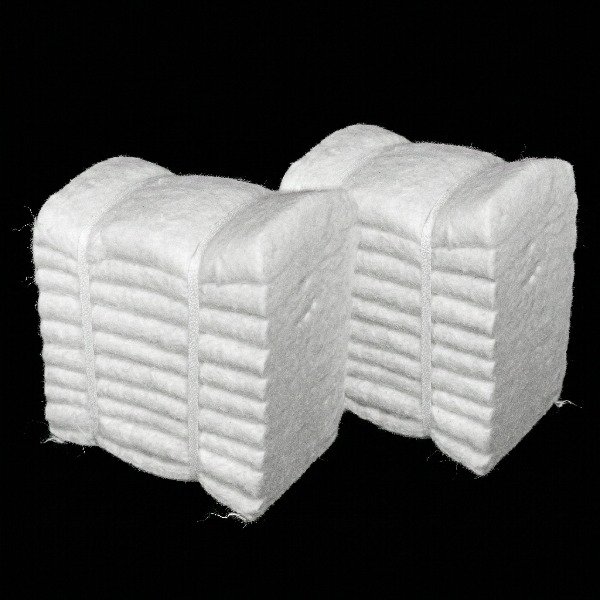
Ceramic Module (Refractory Lining)
Up to 1260°C
Main applications
outstanding installation speed combined with thermal efficiency
Key Features
Standard 1260°C refractory performance
RCF-based, classified at 1260°C — most stable in continuous service between 1000 and 1100°C
Built-in shrinkage compensation
Removing the banding after installation lets the module expand, closing gaps automatically and eliminating thermal bridging
Rapid large-area installation (anchor system)
Fixed directly to the wall with dedicated anchors — far faster than conventional fire brick, shortening project schedules
Excellent thermal shock resistance and light weight
No cracking or spalling under rapid temperature swings, and dramatically lighter than fire brick, easing structural load
High density with elastic recovery
Manufactured up to 240 kg/m³ — strong mechanically, with low thermal conductivity that blocks heat escape effectively
Specifications
| Service temperature | Up to 1260°C |
| Manufactured density | 160–240 kg/m³ (selected by duty) |
| Primary material | High-purity refractory ceramic fiber (RCF) |
| Mounting method | Dedicated anchor fixing |
| Key advantage | Shrinkage compensation, light weight, thermal shock resistance, fast large-area install |
Applications
Steel & metals
- •Reheating and annealing furnace linings
- •Ladle preheater cover linings
Ceramics & glass
- •Pottery kiln insulation
- •Glass annealing lehr linings
Petrochemical
- •Ethylene cracker wall insulation
- •Reformer high-temperature linings
Energy & incineration
- •Large industrial boiler linings
- •Waste incinerator insulation
Notes
- ※Where gas velocity exceeds 40 m/s, an anti-erosion surface coating is required; in strongly alkaline processes, material degradation must be assessed in advance.
- ※We recommend the optimal density (160–240 kg/m³) and anchor type for your site conditions — technical consultation advised.