
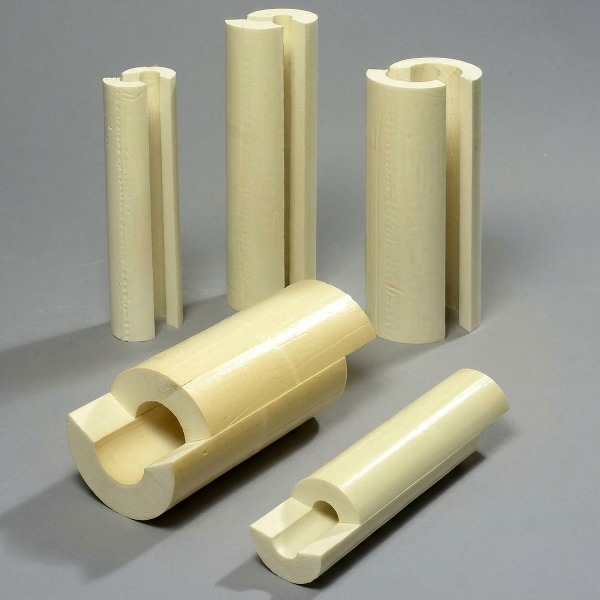
Urethane & Cryogenic Pipe Insulation
PIR Urethane Insulation
Cryogenic −196°CSemi-non-combustible B1130°C heat resistanceSteam piping
Service temperature
Ambient−196°C to +130°C
Main applications
Polyisocyanurate (PIR) foam pipe section+130°C continuous
- 40% better heat resistance than standard PUR
- B1 semi-non-combustible rating
- for steam and hot water lines and fire-rated installations
Key Features
🔥
Heat resistance above 130°C
The PIR (polyisocyanurate) structure greatly raises heat resistance over standard PU — optimised for hot pipework
🛡️
Flame-retardant, semi-non-combustible
PIR foam greatly improves resistance to flame spread over standard PU, meeting building code requirements
🌡️
Very low conductivity retained
λ ≈ 0.020–0.025 W/m·K — insulation performance equal to PU, with heat resistance as well
💧
Closed-cell vapour control
PIR closed cells absorb little moisture, controlling condensation on hot pipework
📏
Every pipe size
Covers 15A to over 400A — custom thicknesses available to order
Specifications
| Material | Rigid PIR (polyisocyanurate) foam |
| Service temperature | −196°C to +130°C (high-temperature grade 150°C) |
| Thermal conductivity | λ ≈ 0.020–0.025 W/m·K |
| Thickness | 25T, 30T, 50T, 60T, 70T, 90T, 100T |
| Applicable pipe sizes | 15A to over 500A |
| Fire rating | Semi-non-combustible (improved over standard PU) |
Applications
Hot pipe insulation
- •Insulation of steam lines (100–130°C)
- •Insulation of hot water and process piping
Building services
- •Pipe insulation where the building code requires semi-non-combustible material
- •Insulation of plant-room piping with flame-retardant requirements
Energy & power
- •High-temperature pipe insulation in power and cogeneration plant
- •Insulation of hot district heating pipework
Petrochemical & process
- •Insulation of process piping above 100°C
- •Pipe insulation in plant with flame-retardant requirements
Notes
- ※Choosing PU or PIR: specify PIR where service exceeds 100°C or a semi-non-combustible rating is required.
- ※Ask in advance if you need fire rating test certificates — they can be issued by specification.