
When choosing pipe insulation, most people think first of glasswool, urethane or rubber foam. But in environments with strict hygiene requirements — cleanrooms, food plants, pharmaceutical and semiconductor facilities — conventional insulation often cannot be used at all. That is where Basofoam comes in.
What is Basofoam?
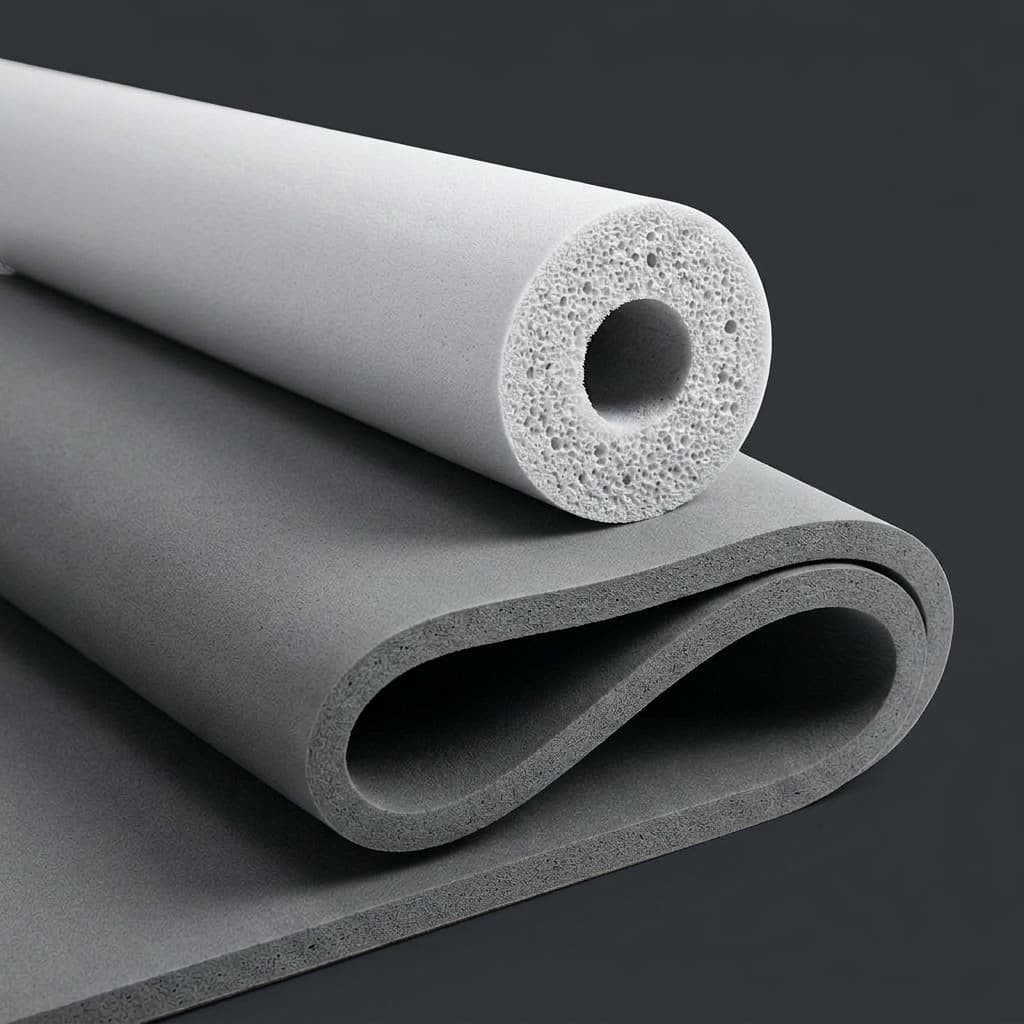
Basofoam is a special foam insulation developed on BASF technology. Its smooth surface and closed-cell structure give it extremely low water absorption, and its non-contaminating, antimicrobial properties make it suitable for hygienic environments meeting FDA requirements. It is supplied both as pipe sections and as sheet and foil-faced sheet.
Key properties
- Service temperature: −40°C to +105°C
- Thermal conductivity: approx. 0.033 W/mK (at 25°C)
- Closed-cell structure — extremely low absorption, excellent condensation control
- Non-contaminating, non-toxic and antimicrobial — meets FDA requirements
- Smooth surface — minimises conditions for bacterial growth
- Highly flexible — easy to install on complex pipe geometry
- Flame-retardant treated — suppresses fire spread
Where it is used
| Cleanroom piping | Hot and chilled water lines in semiconductor, LCD and OLED plants |
| Food plants | Pipe insulation in beverage, dairy and meat processing facilities |
| Pharmaceutical plants | GMP-certified facilities and biopharmaceutical production lines |
| Hospitals & laboratories | Cooling water lines for medical equipment, laboratory piping |
| HVAC ductwork | Condensation control on air conditioning and cooling ducts in clean environments |
Basofoam vs ordinary rubber foam
| Base material | Basofoam: special foam (BASF technology) / ordinary: NBR or EPDM rubber |
| Hygiene | Basofoam: non-contaminating and antimicrobial, meets FDA / ordinary: general industrial |
| Surface texture | Basofoam: smooth closed cell / ordinary: can be somewhat rough |
| Service temperature | Basofoam: −40°C to +105°C / ordinary: −40°C to +110°C (similar) |
| Price | Basofoam: 15–30% higher than ordinary foam |
| Suited to | Basofoam: cleanrooms, food and pharma / ordinary: general industry and construction |
When should you specify Basofoam?
- Facilities that must meet GMP, HACCP, FDA or ISO hygiene requirements
- Semiconductor and display plants requiring a cleanroom class (ISO Class 1–8)
- Environments with direct food contact, or piping near possible food contact
- Facilities that have had mould or contamination problems with ordinary rubber foam
- Buried or concealed piping that is difficult to replace, where durability comes first
💡Basofoam costs more per unit than ordinary insulation, but set against the cost of failing a facility certification and re-doing the installation, choosing the right material from the outset is the economical decision. To discuss whether it applies: +82 10-4266-9745
Need a product quote or technical advice?
Our specialists will respond with a quotation quickly
Related Technical Guides
Technical Guide
Elastomeric Foam Insulation — NBR, EPDM and Atiron for Condensation Control
Technical Guide
Insulation by Industry — Petrochemical, Power, Food, Semiconductor and Shipbuilding
Technical Guide
Cleanroom Insulation Selection — Standards for Semiconductor, Pharma and Food Plants
Technical Guide
The Complete Guide to Urethane Pipe Insulation (PUR/PIR) — Sizes, Uses, Selection