
Urethane pipe insulation — pipe covers — is the most widely used insulation on heating, cooling, hot water supply and district heating pipework. It is also called urethane pipe or urethane section. With so many types and sizes it can be confusing at first, so here are the essentials.
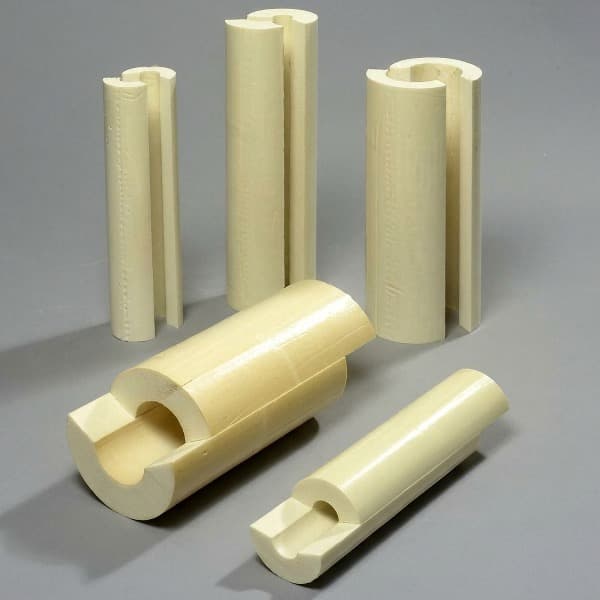
PUR and PIR — what's the difference?
| Name | PUR: polyurethane / PIR: polyisocyanurate |
| Service temperature | PUR: −40°C to +80°C / PIR: −40°C to +120°C |
| Heat resistance | PUR: standard / PIR: better suited to hot service |
| Dimensional stability | PUR: moderate / PIR: excellent (less distortion when hot) |
| Flame retardance | PUR: standard / PIR: relatively better |
| Price | PUR: lower / PIR: about 10–20% higher |
| Main uses | PUR: general heating and cooling pipework / PIR: hot, high-pressure steam lines and process plant |
Sizes — diameter and thickness
Select the bore of urethane pipe insulation to match the nominal pipe size (in A), and set the insulation thickness from your energy-saving target and the applicable legal minimum.
- Pipe sizes: 15A – 500A (covering the full range of general pipework)
- Thicknesses: 25T, 30T, 40T, 50T, 65T, 80T, 100T, 120T
- The insulation bore must match the nominal pipe size exactly for a tight fit
- Thicker insulation performs better, but pipe spacing and loading must be considered
- Mandatory energy-saving regulations (ESCO criteria) set minimum thicknesses by application
Facing types
| Unfaced | Exposed indoor pipework, or where separate cladding is used |
| Aluminum faced | Outdoor pipework, where UV and rain protection is needed |
| Foil faced | Indoor appearance finishing, with added condensation control |
| PVC faced | Condensation control on chilled water lines, cold environments |
| GI steel faced | Factory and plant pipework, where impact protection is needed |
Urethane compared with other pipe insulation
| Urethane (PUR/PIR) | Low conductivity (0.022–0.035), light, simple to install — the most general purpose |
| Glasswool pipe section | Usable to 350°C, excellent acoustics — suited to hot pipework |
| Rubber foam | Most flexible, excellent condensation control — suited to small-bore and chilled lines |
| Aerogel | The lowest conductivity, allowing thin sections — the choice where space is tight |
Selection summary
- Ambient to 80°C heating, cooling and hot water lines: PUR urethane pipe insulation
- 80–120°C hot water and steam lines: PIR urethane pipe insulation
- Industrial pipework up to 350°C: switch to glasswool pipe sections
- Hygienic clean environments (cleanroom, food): Basofoam or the Basofoam family
- Confined space or lightweight design: aerogel pipe covers
✅Tell us your pipe size (in A) and service temperature and we will specify the right urethane insulation and thickness straight away. Phone: +82 10-4266-9745 / Email: hangukprovision@gmail.com
Need a product quote or technical advice?
Our specialists will respond with a quotation quickly
Related Technical Guides
Technical Guide
Acoustic Insulation Explained — Absorption vs Blocking, NRC and Density
Technical Guide
Insulation Performance Compared — Thermal Conductivity, R-Value and Thickness
Technical Guide
Silica Materials — Fabrics, Felts and Ropes for Service Above 1000°C
Technical Guide
Pipe Cladding and Jacketing — Aluminum, Stainless Steel and ALGC Compared