
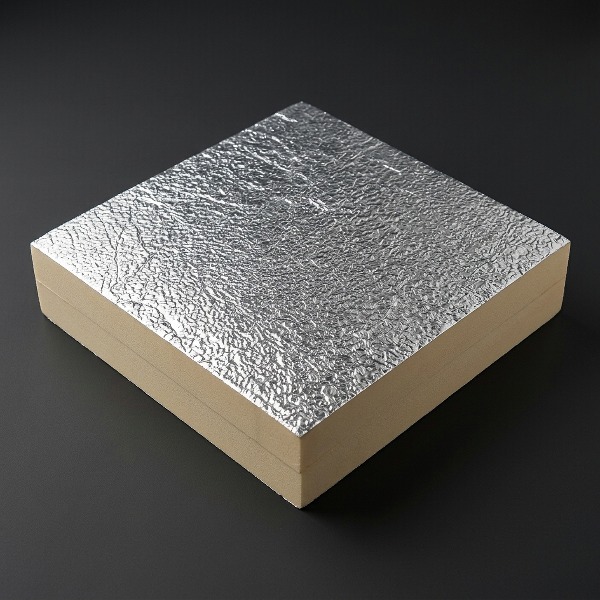
PF Board (Phenolic Foam Board)
−180°C to +120°C
Main applications
PF board meeting the building code while maximising performance
Key Features
Semi-non-combustible — building fire safety
The inherent semi-non-combustibility of phenolic foam suppresses combustion and flame spread, meeting fire code requirements
Best-in-class performance (λ ≈ 0.018–0.023)
The ultra-fine cell structure of PF foam gives the lowest conductivity among semi-non-combustible insulations — high efficiency at low thickness
Rigid, self-supporting board
A rigid foam structure that installs unaided, suitable for both external and internal insulation
Excellent water and vapour resistance
Closed-cell foam with low water absorption — performance stays stable in basements and damp external conditions
Easy to cut on site
Cut easily with ordinary tools and trimmed to fit
Specifications
| Material | Rigid PF (phenolic foam) board |
| Thermal conductivity | λ ≈ 0.018–0.023 W/m·K |
| Service temperature | −180°C to +120°C |
| Thickness | 20T, 25T, 30T, 40T, 50T, 60T, 80T, 100T (standard) |
| Standard sizes | 1,200×2,000 mm (standard) |
| Fire rating | Semi-non-combustible certified |
Applications
Building insulation (semi-non-combustible required)
- •External insulation board where semi-non-combustibility is mandatory
- •Meeting insulation regulations in apartment buildings
Roof insulation
- •Semi-non-combustible insulation board on flat roofs
- •Insulation beneath metal roofs
Industrial refrigeration
- •Wall and ceiling insulation board in cold stores
- •Cryogenic insulation panels
Refurbishment
- •Board improving insulation in existing buildings
- •High-performance insulation in confined spaces
Notes
- ※The first choice for buildings required to use certified semi-non-combustible materials — certificates can be issued.
- ※Finishing and bonding characteristics differ by the aluminum foil facing used — choose the facing to suit the installation.