
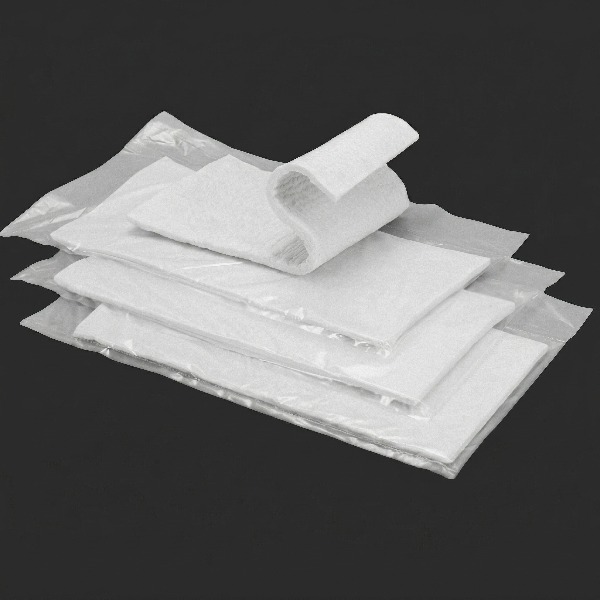
Ceramic Wet Felt
1000–1260°C after drying and firing
Main applications
ceramic wet felt made by a wet process
Key Features
Formable before it dries
Shaped and worked freely while still wet — far easier on complex shapes than dry felt
1000°C+ heat resistance
Ceramic fiber based — once shaped, dried and fired it becomes a refractory shape rated above 1000°C
Conforms to complex shapes
While wet it presses tightly to moulds and equipment — shaped on site to cover even difficult curves
Uniform density
The uniformity characteristic of the wet process gives even heat and insulation performance throughout the part
Shape on site, then dry and fire
Form on site, air-dry or fire, and the part is complete — more freedom of shape than dry forming
Specifications
| Material | Wet-process ceramic fiber (alumina-silica) felt |
| Service temperature | 1000–1260°C after drying and firing |
| Supply form | Wet sheet (roll or cut), supplied damp |
| Thickness | 3–25 mm (custom available) |
| Processing method | Shaped on site, then hardened by air drying or firing |
| Main applications | Complex-shape refractory linings, formed gaskets, heat shield pads |
Applications
Complex-shape linings
- •Refractory linings on curved and irregular areas
- •Locations where dry felt cannot be applied
Formed gaskets & packing
- •Custom-formed gaskets at hot equipment joints
- •Packing pressed to a mould
Furnace & kiln repair
- •Formed filling for partial cracks in furnace walls
- •Formed kiln door seals
Testing & research
- •Custom refractory shapes for pilot furnaces
- •Special refractory shapes for research
Notes
- ※Air-dry for 24–48 hours after forming, then fire with a slow ramp below 100°C — rapid heating causes cracking.
- ※Mould can form during long storage in the wet state — ask us about storage before ordering.