
Surveying a factory, boiler house or pipe gallery built before the 2000s, you will sometimes meet a greyish-white insulation nobody can identify. Suspect asbestos first. Asbestos is a Group 1 carcinogen, and the moment it is disturbed in ignorance, workers and everyone nearby are exposed.
⚠️The one rule that matters most: if you suspect asbestos, never tear, cut or scrape it yourself. Asbestos is relatively low risk while undisturbed, but the instant it is damaged the fibers go into the air. Both identification and removal belong to accredited specialists.
When to suspect asbestos
- Korea banned the manufacture, import and use of asbestos-containing products outright from 2009. Anything installed before that is the first candidate
- Insulation on old boilers and steam lines, particularly hard greyish-white moulded sections
- Gaskets and gland packing on older flanges and valves
- Insulation finishes around boiler shells and flues
- Any plant with no history records, or where insulation replacement cannot be confirmed
✅Appearance alone settles nothing. Asbestos insulation and ordinary inorganic insulation are hard to tell apart by eye. Starting work on the assumption that "it is old but probably fine" is the most dangerous move available.
The identification process
Identification follows an accredited procedure, not your own judgement. For demolition or refurbishment of buildings above a certain size, a prior asbestos survey is a legal requirement, and the survey must be carried out by a designated asbestos survey organisation.
| Step 1 | Check plant history and installation year — consider a survey if it predates 2009 |
| Step 2 | Commission an accredited asbestos survey organisation — sampling and analysis are theirs to do |
| Step 3 | If asbestos is confirmed, engage a registered asbestos removal contractor to plan and notify the work |
| Step 4 | Replace with asbestos-free materials after removal — material selection begins at this stage |
⚠️Asbestos removal may only be carried out by registered contractors, and the work must be notified in advance. Stripping it out with your own staff to save money is both unlawful and a direct risk to their health. Leave survey and removal to the specialists.
Asbestos-free replacements
Once removal is complete, replace like for like with asbestos-free material. There is a modern equivalent for every place asbestos was used.
| Hot pipe insulation | Mineral wool sections (to 600°C), Cerakwool blanket (above 600°C) — inorganic and non-combustible |
| General pipe insulation | Glasswool sections (to 350°C) — economical and general purpose |
| Valve and flange gaskets | Non-asbestos gaskets — Teflon, graphite and aramid based |
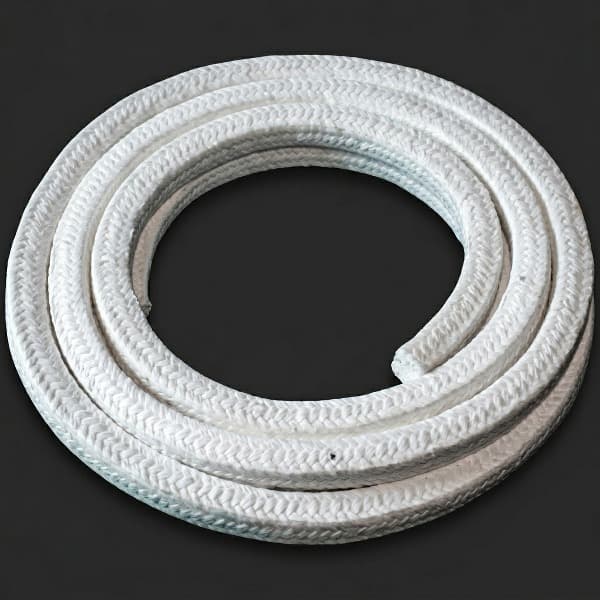
| Gland packing | Non-asbestos gland packing — PTFE, graphite, carbonised fiber (chosen by temperature, pressure and fluid) |
| High-temperature seals and rope | Ceramic rope, silica rope — rated above 1,000°C |
| Heat-resistant fabric and curtains | Silica cloth, ceramic cloth — replacing asbestos cloth |
| Boiler insulation finishes | Cerakwool board and blanket with metal cladding |
Worth improving at the same time
- Review the thickness — installations built to older standards may fall short of current requirements
- Uninsulated valves and flanges — take the opportunity to fit removable jackets
- Replace the cladding throughout — aluminum casing outdoors, ALGC indoors
- Check the vapour barrier — design condensation control into any cold lines at the same time
- Keep the material evidence — asbestos-free declarations and test reports make later inspections far easier
💡Asbestos survey and removal are specialist work and we do not carry them out. What we do handle is everything after removal: selecting and supplying the asbestos-free insulation, packing and sealing materials. Tell us the service temperature, pressure and fluid of the existing material and we will match an asbestos-free equivalent of equal or better performance. Technical advice: +82 10-4266-9745
Need a product quote or technical advice?
Our specialists will respond with a quotation quickly
Related Technical Guides
Technical Guide
Sealing High-Temperature Equipment — Ceramic Rope, Ceramic Paper, Silicone and Gland Packing
Technical Guide
Insulation Service Life — When Should It Be Replaced?
Technical Guide
Insulation Installation Checklist — Ten Things to Verify on Site
Technical Guide
Ceramic Fiber Module Linings — Why Kilns and Furnaces Are Switching from Brick