
When a kiln or heat-treatment furnace is due for relining, customers often ask whether to rebuild with firebrick or switch to ceramic fiber modules. The short answer: if the furnace runs continuously at around 1,100°C or below and the lining sees no mechanical impact or molten material, a module lining is usually the better choice. It is lighter, heats up faster and goes in quicker.
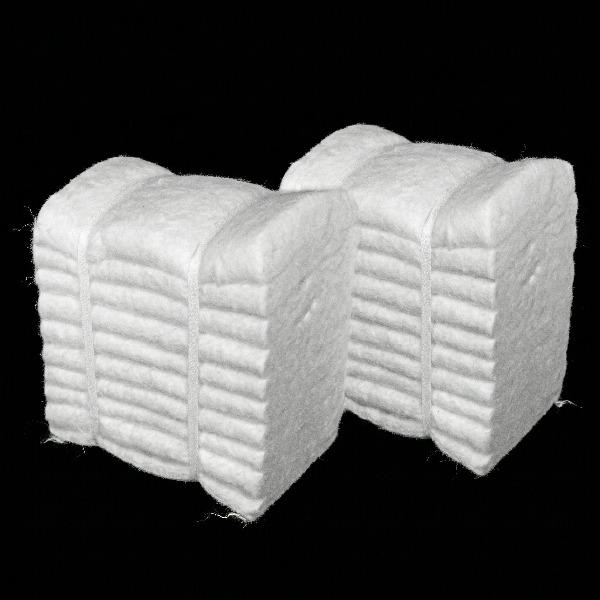
What a ceramic fiber module is
A module is ceramic fiber blanket folded like an accordion, compressed and strapped, with anchor hardware built into the back. Each module is fixed to anchors welded to the furnace shell. Once installed, the straps are cut and the compressed fiber springs back, pressing the modules tightly against each other. That recovery offsets the shrinkage that happens at high temperature and keeps the joints closed.
Compared with firebrick and castable
| Weight | A fraction of firebrick — far less load on the shell and structure |
| Heat storage | Very low, so the furnace heats and cools quickly — large fuel savings on intermittent operation |
| Thermal shock | Modules do not crack under rapid heating or cooling. Brick can spall and crack |
| Installation time | Dry installation with no curing or dry-out. Castable needs curing and a controlled dry-out |
| Abrasion and impact | Brick and castable win — modules are unsuitable where charge material strikes or slag and molten metal make contact |
| High-velocity gas | Surfaces hit directly by strong flame or fast flue gas can erode — consider a surface rigidizer |
✅Modules are not a cure-all. The most common design is a hybrid: keep brick or castable on the hearth, charging door and burner surrounds where there is load or wear, and convert the side walls and roof to modules.
Choosing the grade — one step above furnace temperature
A ceramic fiber's classification temperature is close to its upper limit. For a long, stable service life, choose a grade with headroom above the actual furnace temperature.
| Furnace up to 1,000°C | 1260°C grade (STD/HP) — heat-treatment, drying and general firing furnaces |
| Furnace 1,000–1,150°C | 1260°C HP grade or consider HTZ — the difference in shrinkage decides service life |
| Furnace above 1,150°C | 1430°C HTZ grade — high-temperature firing furnaces and ceramic kilns |
| Frequent worker exposure | Consider bio-soluble fiber modules — check the temperature limit |
Anchors and layout patterns
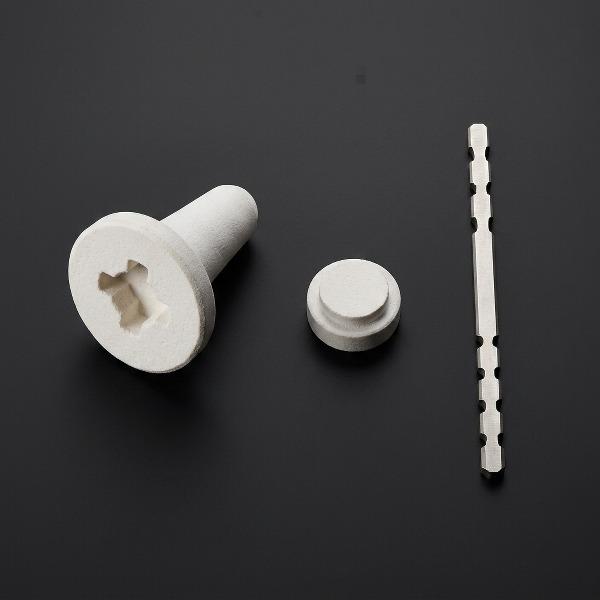
- Choose anchor material for the temperature at the shell side — typically SUS304 or SUS310S, Inconel-type alloys for hotter zones
- Soldier pattern: all modules face the same way, with blanket strips inserted between rows to compensate for shrinkage
- Parquet pattern: alternate module direction by 90°. Shrinkage is spread in all directions, so gaps are less likely
- On the roof, check anchor spacing and fixing method separately, allowing for the direction of load
- A backup layer of ceramic fiber blanket behind the modules lowers the shell temperature further
Common installation problems
- Cutting the straps too early — the next module becomes hard to fit and compression releases unevenly
- Too little compression between modules — joints open after the first heat-up and heat escapes
- Unfinished areas around burners and sight ports — fill openings separately with bulk fiber or blanket
- Welding anchors onto a rusty or dirty shell — weak fixing leads to sagging modules over time
- Skipping surface treatment — in furnaces with fast flue gas, a rigidizer coat limits fiber shedding and erosion
⚠️When installing ceramic fiber (RCF), wear a dust mask, coveralls and safety glasses, and control dust during cutting and removal. Fiber that has been in long service can contain crystallized dust when torn out, so respiratory protection matters most at demolition.
💡Send us the furnace's internal dimensions, maximum operating temperature, whether it runs continuously or intermittently, and the existing lining type. We will work out the module grade, thickness and quantity along with the anchor specification, and can supply modules, anchors, backup blanket and rigidizer together. Technical support: +82 10-4266-9745
Need a product quote or technical advice?
Our specialists will respond with a quotation quickly
Related Technical Guides
Technical Guide
Refractories Explained — Castables, Fire Brick and Refractory Mortar
Technical Guide
Sealing High-Temperature Equipment — Ceramic Rope, Ceramic Paper, Silicone and Gland Packing
Technical Guide
Firestopping Compartment Penetrations — Certified Systems and Common Site Misconceptions
Technical Guide
HVAC Duct Insulation and Acoustics — Internal Lining vs External Wrap