
However thick you build a wall, a single pipe passing through it gives fire and smoke a route across. A fire compartment performs only as well as its weakest point, and that point is the penetration. Yet on site these openings are often packed with ceramic rope or fire tape. That does not meet the legal requirement.
What a firestop seal is
Where pipework, conduit, cable tray or ductwork passes through a fire compartment — a fire-rated wall or floor — the gap must be sealed so that flame, smoke and heat cannot cross during a fire. In buildings subject to Korea's fire compartment requirements, treating these penetrations is mandatory.
⚠️This is the key point. A statutory fire compartment penetration must use a quality-certified firestop system, installed exactly to its certified specification. Packing the opening with general refractory materials — ceramic rope, silica tape, refractory mortar — does not qualify as a firestop system. It will be flagged at handover inspection and have to be redone.
Why general refractory materials do not work
A firestop is not simply non-combustible material stuffed into a hole. It is a single system designed and tested against the pressure and thermal expansion a fire produces, including the deformation and melting of whatever passes through it. A plastic pipe, for instance, melts away in a fire, so an intumescent material has to expand and close that space. No amount of tightly packed ceramic rope replicates that behaviour.
| Unit of certification | Not the material alone but the whole combination — wall type, penetrating service, seal material and installation method |
| By service type | Steel pipe, plastic pipe, cable and duct each have their own test and certification |
| Installation scope | Departing from the certified thickness, depth, opening size or clearance voids the certification |
| Evidence | Keep the certificate, installation photographs and material delivery records together |
Four misconceptions we see repeatedly
- "Non-combustible is non-combustible" — a fire rating and firestop certification are entirely separate schemes
- "It is packed solid with ceramic rope" — without a certified system it is treated the same as no seal at all
- "Mortar is stronger" — without behaviour designed for the specific penetrating service it does not qualify
- "Anyone can install it" — it is only effective if installed to the certified specification with evidence retained
So where do ceramic rope and silica tape belong?
These materials are not for statutory fire compartment penetrations. They are for sealing and insulating hot equipment. The purposes are clearly different.
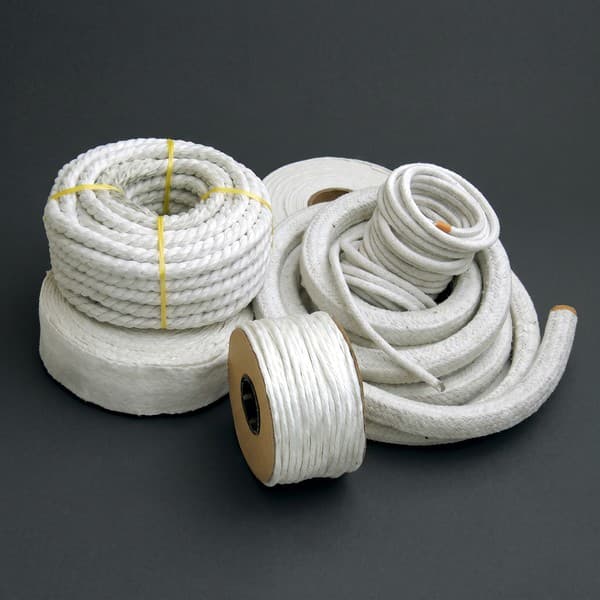
| Ceramic / silica rope | Gas-tight sealing of kiln and furnace doors, hot flange packing, expansion joint filling |
| Silica / fire tape | Sealing hot pipe joints, refractory finishing of gaps between equipment |
| Cerakwool blanket and bulk | Filling expansion joints in furnace walls, insulating gaps in hot equipment |
| Refractory mortar / castable | Fire brick joints, furnace wall repair |
✅In short: statutory fire compartment penetrations take certified firestop products; gaps and seals on hot equipment take ceramic rope, silica tape and Cerakwool. The two must not be mixed.
Checklist before installation
- Confirm from the drawings whether this is a statutory fire compartment or simply a services opening
- Identify the penetrating service — steel, stainless, plastic pipe, cable or duct each need a different system
- Confirm the wall or floor type and thickness — the certification covers the substrate too
- Check that the opening size and clearance fall within the certified range
- Keep installation photographs and material evidence for the handover inspection
💡Statutory fire compartment penetrations need certified products installed to a certified specification. For sealing and insulating hot equipment, however, ceramic rope, silica tape and Cerakwool are the right answer. If you are unsure which applies, send us a drawing or photograph — we will distinguish the two and specify materials for the non-statutory sections. Technical advice: +82 10-4266-9745
Need a product quote or technical advice?
Our specialists will respond with a quotation quickly
Related Technical Guides
Technical Guide
Seven Common Insulation Selection Mistakes Seen on Site
Technical Guide
Sealing High-Temperature Equipment — Ceramic Rope, Ceramic Paper, Silicone and Gland Packing
Technical Guide
Ceramic Fiber Module Linings — Why Kilns and Furnaces Are Switching from Brick
Technical Guide
Preventing Condensation — Dew Point, Vapour Barriers and Material Choice