
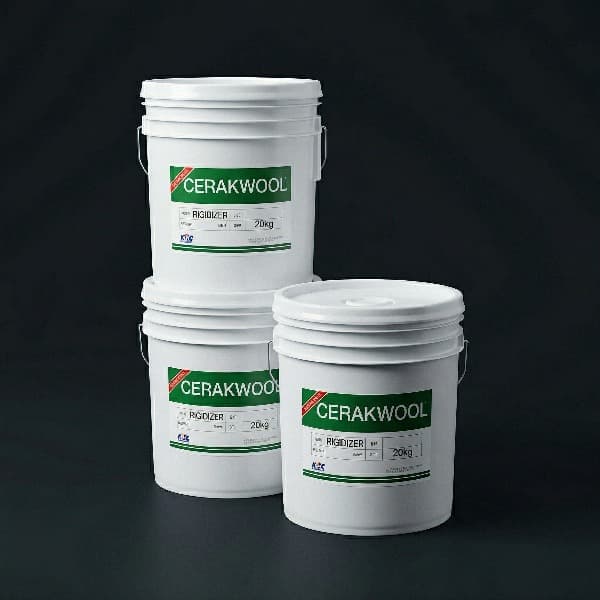
Cerakwool (ceramic fiber) blanket and board are light and insulate excellently, but the surface is soft and mechanically weak, so wind, vibration and contact damage it easily. Rigidizers and ceramic bonds are applied to that surface to harden it or to give it adhesion. On site they go by many names — rigidizer, hardener, ceramic coating, Super 3000.
Why hardeners and bonds are needed
- Surface hardening — preventing fiber release from Cerakwool blanket and raising mechanical strength
- Gas velocity resistance — preventing fiber erosion under high-velocity gas flow
- Shape retention — fixing the installed form and holding module and block structures
- Adhesion — bonding ceramic to ceramic, or to metal and refractories
- Crack repair — filling and repairing cracks in existing refractory and insulation linings
- Dust suppression — reducing airborne fiber in the working environment
1. Rigidizer
A rigidizer is an inorganic liquid hardener that penetrates the ceramic fiber surface and binds the fibers together. Applied, dried and fired, it hardens the surface and greatly increases its strength.
- Main components: colloidal silica or alumina sol
- Service temperature: up to 1300°C (by material grade)
- Application: brush, spray or dip
- Air-dry for 24 hours after application, then ramp the temperature up slowly and fire
- Increases surface hardness, prevents fiber release, adds resistance to gas velocity erosion
- Main uses: surface hardening of Cerakwool blanket and board, incinerator and heat-treatment furnace walls, heat-resistant duct linings
2. Ceramic bond (castable binder)
A ceramic bond is a heat-resistant adhesive joining ceramic to ceramic, or ceramic to metal and refractories. It is more viscous and has stronger adhesion than a rigidizer.
- Main components: refractory inorganic binder (alumina or silica based) with heat-resistant filler
- Service temperature: up to 1600°C (by product)
- Viscosity: paste to liquid (selected for application or filling)
- Application: trowel or spatula, filling for crack repair, or applied to mating faces and pressed together
- Curing: air-cured, then heat-fired to develop strength
- Main uses: joining Cerakwool modules, repairing fire brick and castables, filling incinerator cracks, furnace lining repair
3. Super 3000
Super 3000 is a brand of high-temperature refractory adhesive, and on site the name is used almost generically for ceramic bonding and repair products. The name reflects its usability to 3000°F (about 1650°C).
- Service temperature: up to 1650°C (per the product specification)
- High-strength refractory bonding — joining fire brick, ceramic fiber and castables
- Specialised for crack repair — filling and patching in incinerators, kilns and heat-treatment furnaces
- Excellent oxidation and thermal shock resistance
- Use: clean the crack, fill it, finish the surface, then ramp the temperature up slowly and fire
- Main uses: industrial furnace repair, incinerator wall patching, sealing ceramic fiber module joints
4. Ceramic coating
A ceramic coating forms a thin ceramic film on the insulation surface, raising heat resistance, corrosion resistance and radiant efficiency. It resembles a rigidizer, with the added purpose of improving emissivity.
- Service temperature: up to 1400°C
- Improved emissivity — increasing radiant heat transfer inside the furnace and saving energy
- An infrared coating effect — reaching a higher furnace temperature for the same energy input
- Erosion-resistant coating — protecting the ceramic fiber surface in high-velocity gas
- Applied, dried and fired to form the film
- Main uses: wall coatings in heat-treatment and firing furnaces, energy-saving relining, surface treatment of Cerakwool modules
5. Refractory mortar
Refractory mortar is a heat-resistant filler used for fire brick joints and crack repair. It has a higher mineral content than ceramic bond and suits thicker fills.
- Service temperature: up to 1700°C (by alumina content)
- Bonding and filling fire brick joints
- Repairing thick cracks (5 mm and above) — better than ceramic bond here
- Two types: air-setting and heat-setting
- Main uses: fire brick installation and repair, jointing in incinerators, kilns and coke ovens
At a glance
| Rigidizer | Surface hardening of Cerakwool blanket and board — penetrating liquid, sprayed or brushed |
| Ceramic bond | Bonding ceramics and filling cracks — paste form, up to 1600°C |
| Super 3000 | Specialist high-temperature refractory bonding and repair — to 1650°C, crack patching |
| Ceramic coating | Surface film plus improved radiant efficiency — with energy saving as an added purpose |
| Refractory mortar | Fire brick joints and thick crack repair — to 1700°C |
Installation points that apply to all of them
- Clean the surface before application — dust, oil and debris must be removed for the bond to develop
- Never ramp the temperature quickly — rapid vaporisation of water causes cracking and delamination, so dry and fire slowly
- Storage: prevent freezing (never store below 0°C), keep sealed and cool
- Observe the mixing ratio — follow the manufacturer's dilution rate; over-dilution reduces strength
- Use promptly after opening — long storage leads to gelling
✅Tell us the material involved (Cerakwool, fire brick, castable), the service temperature and the purpose (surface hardening, bonding, crack repair, energy saving) and we will recommend the right hardener or bond. Technical advice: +82 10-4266-9745
Need a product quote or technical advice?
Our specialists will respond with a quotation quickly
Related Technical Guides
Technical Guide
Silica Materials — Fabrics, Felts and Ropes for Service Above 1000°C
Technical Guide
Pipe Cladding and Jacketing — Aluminum, Stainless Steel and ALGC Compared
Technical Guide
Refractories Explained — Castables, Fire Brick and Refractory Mortar
Technical Guide
Seven Common Insulation Selection Mistakes Seen on Site