
The question we field most often on site is whether glasswool will do or whether the job needs mineral wool. Both are inorganic, non-combustible and look much alike, but they differ in service temperature and price. Specify mineral wool where glasswool would do and you waste money; specify glasswool where mineral wool is needed and the material collapses. Here is how to decide.
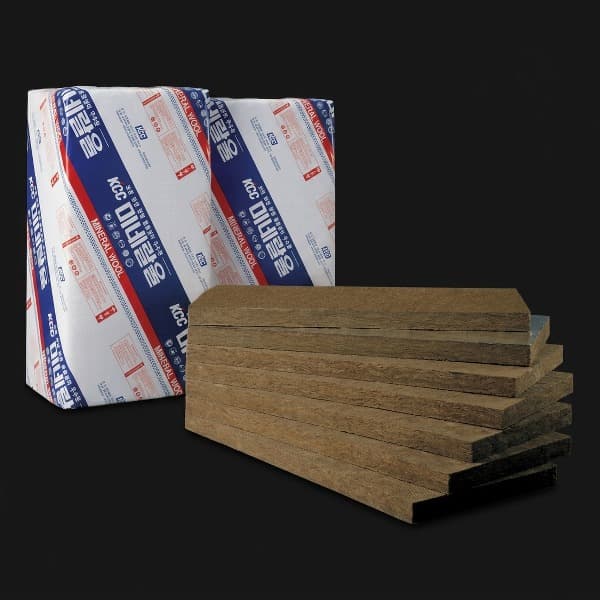
What mineral wool is
Mineral wool is an inorganic insulation made by melting natural minerals such as basalt and iron ore above 1,500°C and spinning them into fiber centrifugally. It is also called rock wool. Because the raw material is stone, its melting point is higher than glasswool's — and so is the temperature it will take.
Key specifications
| Service temperature | Ambient to 600°C (650–750°C on some products) |
| Thermal conductivity | λ ≈ 0.034–0.040 W/m·K at ambient |
| Density | 40K – 200K (by application) |
| Fire rating | Non-combustible — inorganic, releases no toxic gas |
| Acoustics | Excellent — porous fiber structure |
| Standard | KS L 9102 (man-made mineral fiber insulation) |
Forms and where they are used
| Board | Wall and ceiling insulation, equipment casing panels. Higher density stands unaided |
| Wired mat | Held by wire mesh. Wrapped around large-bore pipework and tank curvature |
| Pipe section | Cylindrical. The standard for medium- and high-temperature pipe insulation |
| Lamella mat | Fibers oriented vertically. Two to three times the compressive strength — made for EIFS |
| Loose wool | For blowing and filling. Retrofits, tight spaces, gap filling |
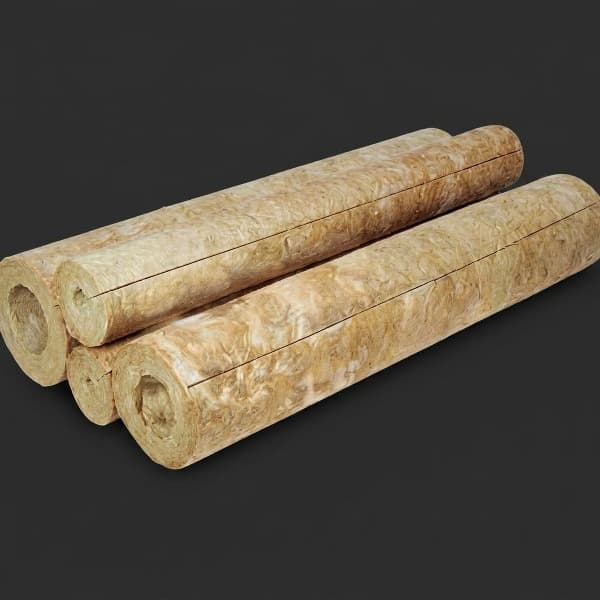
Head to head with glasswool
| Raw material | Glasswool: glass / mineral wool: basalt and iron ore |
| Service temperature | Glasswool: to 350°C / mineral wool: 600°C and above — the decisive difference |
| Thermal conductivity | Almost identical (0.033–0.040) — little difference at ambient |
| Weight | Glasswool lighter / mineral wool heavier |
| Acoustics | Both excellent / mineral wool slightly better at low frequencies |
| Price | Glasswool cheaper / mineral wool dearer |
| Fire | Both non-combustible / mineral wool more stable under sustained heat |
✅On ambient insulation performance alone the two are comparable. You pay more for mineral wool to buy temperature and fire performance, not insulation. Below 350°C on general pipework, glasswool is the sensible choice.
When to specify mineral wool
- Pipework or equipment above 350°C — glasswool shrinks and melts in this range
- Fire compartment boundaries — where the material must hold its form under prolonged flame
- External wall systems (EIFS) — where lamella compressive strength is required
- Generator and plant rooms — where acoustics and fire performance are both needed
- Marine fire bulkheads — meeting standards such as IMO A-60
- Large-bore pipework — dedicated sections above 200A are available
When glasswool is enough
- General pipe and duct insulation below 350°C
- Filling building wall cavities
- Partition and ceiling acoustics
- Budget-constrained sites with ample temperature margin
Above 600°C
Mineral wool has a limit too. Above 600°C continuous service you move up to Cerakwool (ceramic fiber): 600–1,000°C calls for the 1100°C Cerakwool grade or silica materials, and above 1,000°C for the 1260°C and HTZ 1430°C grades.
⚠️Installation can irritate skin and airways. Wear a dust mask, gloves and goggles, and ensure ventilation. Cutting generates considerable dust.
💡Tell us the operating temperature, pipe size or area, and the environment (indoor or outdoor, fire requirements) and we will advise whether glasswool or mineral wool fits and calculate the density and thickness. Technical advice: +82 10-4266-9745
Need a product quote or technical advice?
Our specialists will respond with a quotation quickly
Related Technical Guides
Product Guide
Choosing a Welding Blanket — Fiberglass vs Silica vs Ceramic Cloth
Technical Guide
Acoustic Insulation Explained — Absorption vs Blocking, NRC and Density
Technical Guide
Insulation Service Life — When Should It Be Replaced?
Technical Guide
Insulation Performance Compared — Thermal Conductivity, R-Value and Thickness