
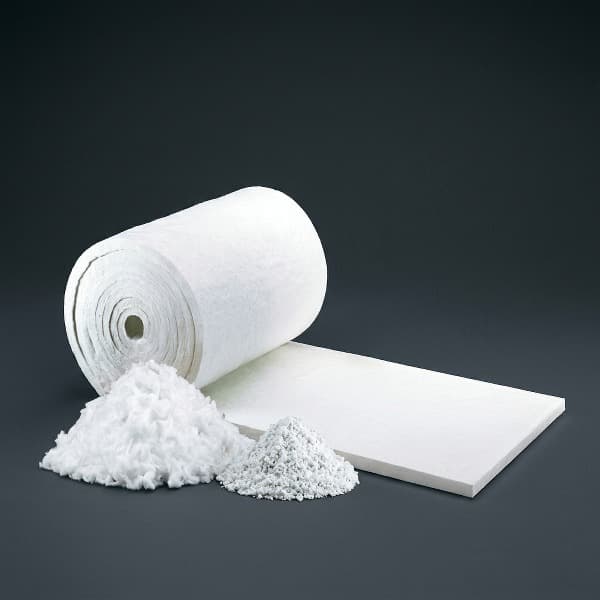
Cerakwool (ceramic fiber) all looks like the same material, but composition and heat resistance differ completely by grade. Choose the wrong grade and the material shrinks or melts, loses its insulating function and damages the plant. This guide sets out the Cerakwool grades that are most often confused on site.
How grades are defined — classification vs actual service temperature
The number in a Cerakwool grade (1100, 1260, 1430) is the classification temperature: the maximum temperature at which permanent linear shrinkage stays within 4%. Recommended continuous service temperature is normally set 100–150°C below the classification temperature.
1. 1100°C grade (standard)
- Composition: Al₂O₃ 45–47% + SiO₂ 53–55%
- Classification temperature: 1100°C / recommended continuous: up to 950°C
- The most general-purpose and economical Cerakwool
- Thermal conductivity at 600°C: approx. 0.18 W/mK
- Forms: blanket, board, module, paper, rope, bulk
- Main uses: heat-treatment, drying and firing furnace linings (plant below 1000°C)
2. 1260°C grade (high temperature)
- Composition: Al₂O₃ 52–54% + SiO₂ 46–48% (higher alumina content)
- Classification temperature: 1260°C / recommended continuous: up to 1100°C
- Better heat and shrinkage resistance than the 1100°C grade
- Thermal conductivity at 600°C: approx. 0.17 W/mK
- Forms: blanket, board, module, paper, rope
- Main uses: petrochemical heaters, incinerators, glass melting furnaces, plant at 1100–1200°C
3. HTZ 1430°C grade (extreme temperature)
- Composition: Al₂O₃ 95%+ (high-purity alumina with zirconia addition)
- Classification temperature: 1430°C / recommended continuous: up to 1300°C
- Zirconia (ZrO₂) addition greatly improves heat and shrinkage resistance
- Suppresses devitrification at temperature
- Price: three to five times the 1100°C grade
- Main uses: steel mill reheating furnaces, petrochemical crackers, glass and ceramic kilns, plant above 1300°C
4. Bio-soluble ceramic fiber (New Bio)
Conventional Cerakwool (aluminosilicate) is classified by IARC in Europe as Group 2B, possibly carcinogenic. New Bio, a bio-soluble fiber, dissolves and clears from the body, offering the same performance with substantially improved human safety.
- Classification temperature: 1000–1200°C (by grade)
- Bio-soluble — inhaled fiber dissolves and is cleared, a safety improvement over conventional Cerakwool
- Not subject to EU carcinogen regulation (SVHC)
- Increasingly adopted at sites with strict worker health requirements
- Main uses: hot plant below 1200°C, products and equipment exported to Europe, sites with tightened worker safety standards
At a glance
| 1100°C (standard) | Al₂O₃ 46% / continuous 950°C / most economical / heat-treatment and drying furnaces |
| 1260°C (high temperature) | Al₂O₃ 53% / continuous 1100°C / incinerators and petrochemical heaters |
| HTZ 1430°C | Al₂O₃ 95%+ / continuous 1300°C / steel, crackers and extreme-temperature plant |
| New Bio | Bio-soluble / below 1200°C / sites with tightened worker safety standards |
⚠️It is safer to choose a Cerakwool grade one step above your plant temperature — for example, continuous service at 1050°C calls for the 1260°C grade. If the choice is difficult, tell us the equipment and its service temperature. Technical advice: +82 10-4266-9745
Need a product quote or technical advice?
Our specialists will respond with a quotation quickly
Related Technical Guides
Technical Guide
Silica Materials — Fabrics, Felts and Ropes for Service Above 1000°C
Technical Guide
Insulation Service Life — When Should It Be Replaced?
Technical Guide
Refractories Explained — Castables, Fire Brick and Refractory Mortar
Technical Guide
Rigidizers, Ceramic Bonds and Hardeners — Surface Strengthening for Insulation