
Quantities are what most often go wrong in an insulation quotation. Order to the measured pipe length and you will run short on site, without exception. Insulation wraps around the outside of the pipe, so the area derives from the outside diameter of the insulation rather than the pipe — and fittings such as elbows and valves consume far more than straight runs. Here is the method, in order.
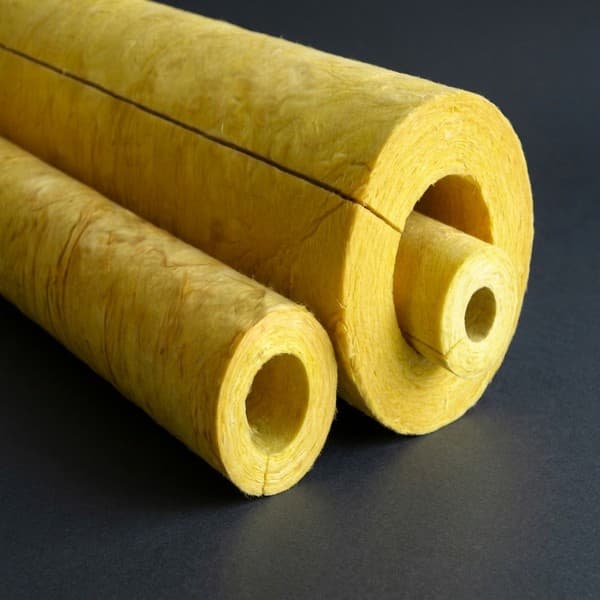
1. Start with a pipe schedule
Group the pipework by size and extract the lengths from the drawings. Even at the same diameter, a different operating temperature means a different thickness, so lines must be separated. At minimum you need four values: nominal size, length, operating temperature and location.
| Size | Nominal diameter in A (15A, 25A, 50A, 100A …) |
| Length | Total of the straight runs, in metres |
| Operating temperature | The value that determines insulation thickness |
| Location | Outdoors changes the cladding specification |
2. Fix the insulation thickness first
Area cannot be calculated until thickness is settled. Take the greatest of the surface-temperature requirement, the dew point requirement for condensation control, the economic thickness and the legal minimum. Where a specification exists, the specification governs.
3. Calculate the insulated surface area
This is the basis for both insulation and cladding quantities. Add the insulation thickness to each side of the pipe outside diameter, take that circumference and multiply by length.
| Formula | A = π × (D + 2T) × L (D: pipe outside diameter, T: insulation thickness, L: length — keep units consistent) |
| Example | 100A pipe (OD approx. 114 mm), 50T insulation, 20 m → π × (0.114 + 0.1) × 20 ≈ 13.4 m² |
| Watch out | Nominal size (100A) and actual outside diameter (114 mm) are not the same. Always use the outside diameter |
⚠️Calculating from nominal size rather than outside diameter leaves you systematically short, and the error grows with pipe size.
4. Convert fittings to equivalent length
Fittings have large surface areas and are harder to insulate, so counting them as straight pipe always leaves you short. In practice each fitting is converted into an equivalent length of straight pipe and added. Conversion factors vary by size and specification, so check the project specification first and follow the client's basis if none exists.
- Elbows, tees and reducers — add as equivalent straight length
- Valves and flanges — more accurate to quantify separately as insulation jackets (quantity × size)
- Hanger and support sections — allow for continuous insulation so the run is not interrupted
- Pumps, heat exchangers and similar — measure the surface area directly or take it from the drawings
5. Quantify cladding and accessories separately
Cladding wraps around the insulation, so its area exceeds the insulated surface area, and laps add more. Leave the accessories out and the site stops, so quantify them at the same time.
| Cladding (casing, ALGC) | Insulated surface area plus lap allowance. Aluminum casing outdoors, ALGC indoors is typical |
| Insulation pins and clips | By quantity per unit area — essential on ducts and flat surfaces |
| Finishing tape | ALGC and mastic tape — by joint length |
| Bands and screws | For fixing cladding — by pipe length and circumference |
| Sealant | Waterproofing outdoor joints — by joint length |
6. Apply an allowance
Add an allowance for cutting waste, laps and damage during installation. The rate varies with material and site conditions, so confirm it against the specification or the client's basis. Complex pipe networks, runs with many fittings and curved equipment all waste more.
✅Pipe sections are standard products and waste little; roll and blanket that has to be cut wastes considerably more. The same area can translate into quite different order quantities depending on the form of the material.
7. Convert to order units
Finally, convert the calculated areas and lengths into the units the material is actually sold in — rolls or m² for roll goods, pieces for pipe sections, sheets for board, rolls for tape. Round up and you have the order quantity.
💡Send us the pipe schedule (size, length, operating temperature) and fitting counts and we will calculate the insulation, cladding and accessories and return it as a quotation. A drawing file, a spreadsheet or a handwritten list all work. Enquiries: +82 10-4266-9745 / sebangprovision@gmail.com
Need a product quote or technical advice?
Our specialists will respond with a quotation quickly
Related Technical Guides
Technical Guide
Sealing High-Temperature Equipment — Ceramic Rope, Ceramic Paper, Silicone and Gland Packing
Technical Guide
Ceramic Fiber Module Linings — Why Kilns and Furnaces Are Switching from Brick
Technical Guide
Identifying Asbestos Insulation and Replacing It — A Checklist for Ageing Plant
Technical Guide
Calculating Insulation Payback — Turning Heat Loss into Money