
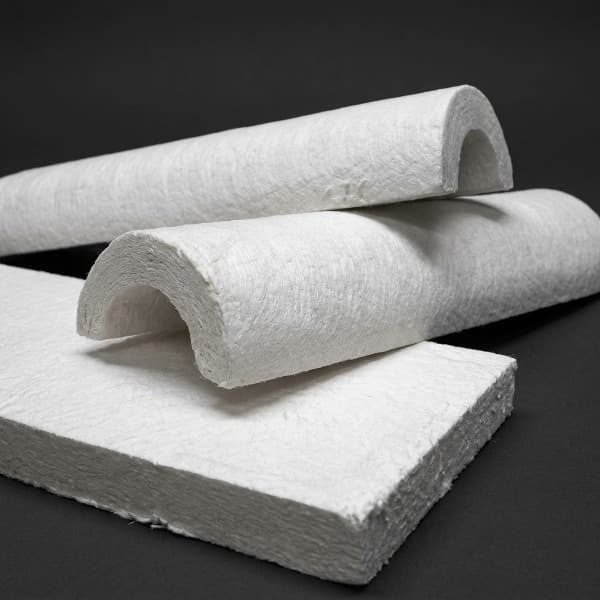
Perlite is an inorganic insulation made by expanding a glassy volcanic rock at high temperature. Stable above 1000°C, with excellent chemical resistance and non-combustibility, it has long been used in petrochemicals, power generation and steelmaking. On site it is called expanded perlite or perlite insulation.
Key properties
- Service temperature: −200°C to +1000°C, covering cryogenic through to hot service
- Non-combustible — an inorganic material that does not burn and releases no toxic gas
- Thermal conductivity: 0.045–0.070 W/mK (by fill density)
- Excellent chemical resistance — strong against most acids and alkalis
- Low water absorption — vacuum-filled perlite has excellent vapour resistance
- Light — minimising installed load when used as a fill
- Forms: loose fill, perlite pipe sections, perlite board and block
Where it is used
| LNG cryogenic tanks | Vacuum-filled perlite between the inner and outer tanks — the standard cryogenic insulation method |
| Industrial pipe sections | Cylindrical perlite sections for hot pipework (300–1000°C) |
| Petrochemical plant | Insulation of hot, high-pressure pipework and equipment |
| Power station steam lines | Insulation of hot steam lines and sections requiring fire performance |
| Steelworks and furnaces | Blocking radiant heat where non-combustible material is mandatory |
| Building fire protection | Fire protection to steelwork, filling hollow slabs |
Perlite compared with other insulation
| Perlite | Non-combustible, chemically resistant, −200 to 1000°C / cryogenic tank fill and hot pipe sections |
| Glasswool | Non-combustible, light, 350°C / general pipework, ducts and building insulation |
| Mineral wool | Non-combustible, 600°C / medium- and high-temperature plant, fire compartments |
| Cerakwool | Non-combustible, 1430°C / extreme-temperature furnaces and incinerators |
| Aerogel | Non-combustible, 650°C / minimum thickness, confined spaces |
Why perlite is used in LNG tanks
An LNG storage tank has roughly a 200°C difference between the inside (−162°C) and the outside (ambient). In that extreme condition perlite is filled under vacuum between the inner and outer tanks, reducing heat transfer to an extreme degree. Vacuum perlite insulation is the industry standard for LNG tanks, holding energy loss below 0.05% per day.
💡Perlite insulation comes in different forms depending on the environment (cryogenic, hot, fill or pipe section). Tell us the pipe size, service temperature and installation conditions and we will advise on the right specification. Enquiries: +82 10-4266-9745
Need a product quote or technical advice?
Our specialists will respond with a quotation quickly
Related Technical Guides
Technical Guide
Silica Materials — Fabrics, Felts and Ropes for Service Above 1000°C
Technical Guide
Insulation Service Life — When Should It Be Replaced?
Technical Guide
Insulation Performance Compared — Thermal Conductivity, R-Value and Thickness
Technical Guide
Glasswool vs Mineral Wool vs Cerakwool — Choosing Insulation by Temperature