
Cryogenic pipe insulation is fundamentally different from ordinary insulation work, because the objective is not to stop heat escaping but to stop ambient heat getting in. On sites handling LNG, liquid nitrogen or liquid oxygen, the wrong material means boil-off losses, wasted energy and pipe corrosion from condensation.
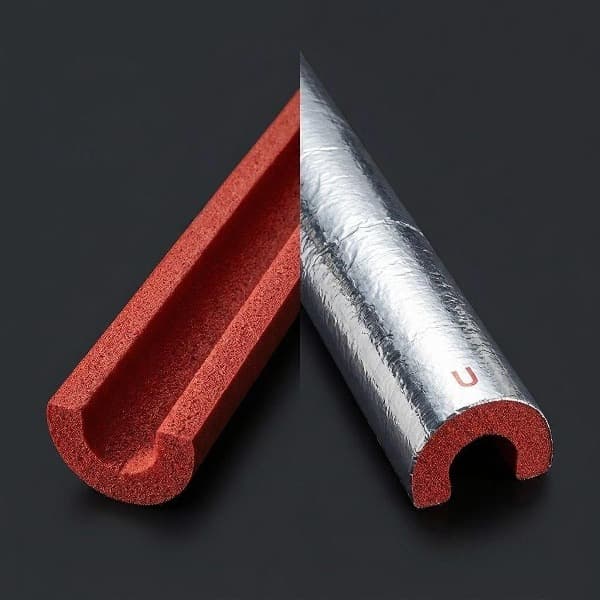
The principle behind cryogenic insulation
A cryogenic line sits more than 200°C below the surrounding air (roughly 20–40°C). The greater that difference, the faster ambient heat enters the pipe and vaporises the fluid. The essentials of material selection are therefore: (1) the lowest thermal conductivity (λ) available; (2) low water absorption, so performance holds even if condensation occurs; and (3) stable properties at low temperature, with no shrinkage or cracking.
The main cryogenic insulation materials
| PIR urethane pipe insulation | Down to −196°C, λ = 0.022 W/mK, the most general purpose |
| PIS foam pipe insulation | Specialised for LNG, excellent cryogenic dimensional stability, marine and process plant |
| Aerogel felt | λ = 0.015 W/mK (the lowest), thin sections, for confined spaces |
| Cellular glass (Foamglas) | Zero water absorption, high compressive strength, for buried pipework |
| Vacuum insulation panels (VIP) | Ultra high performance, for aerospace and specialist industry, very expensive |
PIR urethane — the cryogenic site standard
This is the material used most often on cryogenic sites, applied widely at LNG import terminals, on city gas distribution mains and in hospital liquid nitrogen systems.
- Service temperature: −196°C to +120°C
- Thermal conductivity: approx. 0.022 W/mK at ambient, and lower still when cold
- Closed-cell structure — low water absorption, minimising performance loss if condensation occurs
- Pipe sizes: 15A – 500A
- Thickness: 25T – 120T (chosen from the insulation requirement)
- Facings: aluminum, PVC or foil — choosing a condensation-resistant facing matters
Aerogel — the answer where space is tight
Aerogel is drawing attention in process plant, shipbuilding and semiconductor facilities, where pipework is dense and thick insulation simply cannot be fitted.
- Thermal conductivity of 0.015 W/mK — the lowest of any commercially available insulation
- Achieves the same performance as PIR at half the thickness
- Service range: −200°C to 650°C, covering both cryogenic and hot duty
- Low water absorption — performance stays stable in condensing conditions
- Highly flexible — installable on complex shapes such as valves and elbows
Condensation control — the most important part of the design
On cryogenic pipework, condensation control is not optional. Because the pipe surface is below freezing, moisture entering the insulation freezes, performance collapses and the pipe corrodes.
- A vapour barrier is essential — blocking moisture entering behind the facing
- Seal every joint completely — finish with tape or sealant leaving no gaps
- Facing choice: a composite facing with better vapour resistance than PVC or aluminum is recommended
- For buried pipework: use cellular glass (Foamglas) or a vapour-tight external finish
- Inspect regularly: check every six months for damaged or lifting facing
Cryogenic insulation selection guide
| LNG lines (−162°C) | PIR urethane with a vapour barrier facing, or PIS foam |
| Liquid nitrogen lines (−196°C) | PIR urethane, or aerogel where space is tight |
| Confined-space pipework | Aerogel — maximum performance at minimum thickness |
| Buried pipework | Cellular glass (Foamglas) — compressive strength and waterproofing first |
| Marine & offshore plant | PIS foam or aerogel — for weight saving and vibration resistance |
⚠️In cryogenic insulation, installation method and vapour sealing matter as much as material choice. Condensation and freezing caused by poor installation can damage the pipework. Tell us your site conditions and we will advise on the optimal insulation solution. Technical advice: +82 10-4266-9745
Need a product quote or technical advice?
Our specialists will respond with a quotation quickly
Related Technical Guides
Technical Guide
Insulation Performance Compared — Thermal Conductivity, R-Value and Thickness
Technical Guide
The Complete Guide to Urethane Pipe Insulation (PUR/PIR) — Sizes, Uses, Selection
Technical Guide
Aerogel Insulation — Why It Is Worth the Premium
Technical Guide
Silica Materials — Fabrics, Felts and Ropes for Service Above 1000°C